The Obstacle Is the Way: How Ancient Stoicism Became the Operating System for Modern Greatness
"The impediment to action advances action. What stands in the way becomes the way." — Marcus Aurelius, Meditations 5.20. A deep exploration of stoic philosophy through its three disciplines: perception, action, and will.

A Philosophy Forged in Crisis, Tested by History, Living in You
The most famous line about stoicism doesn't come from a philosophy textbook. It comes from a Roman emperor writing by candlelight during a plague, surrounded by soldiers who are dying, while barbarians press against the empire's northern frontier.
"The impediment to action advances action. What stands in the way becomes the way." — Marcus Aurelius, Meditations 5.20
This is the seed from which everything grows. Not a motivational slogan. Not a self-help catchphrase. A genuine insight into how reality works — observed by a man who had every reason to be bitter and chose, instead, to be useful.

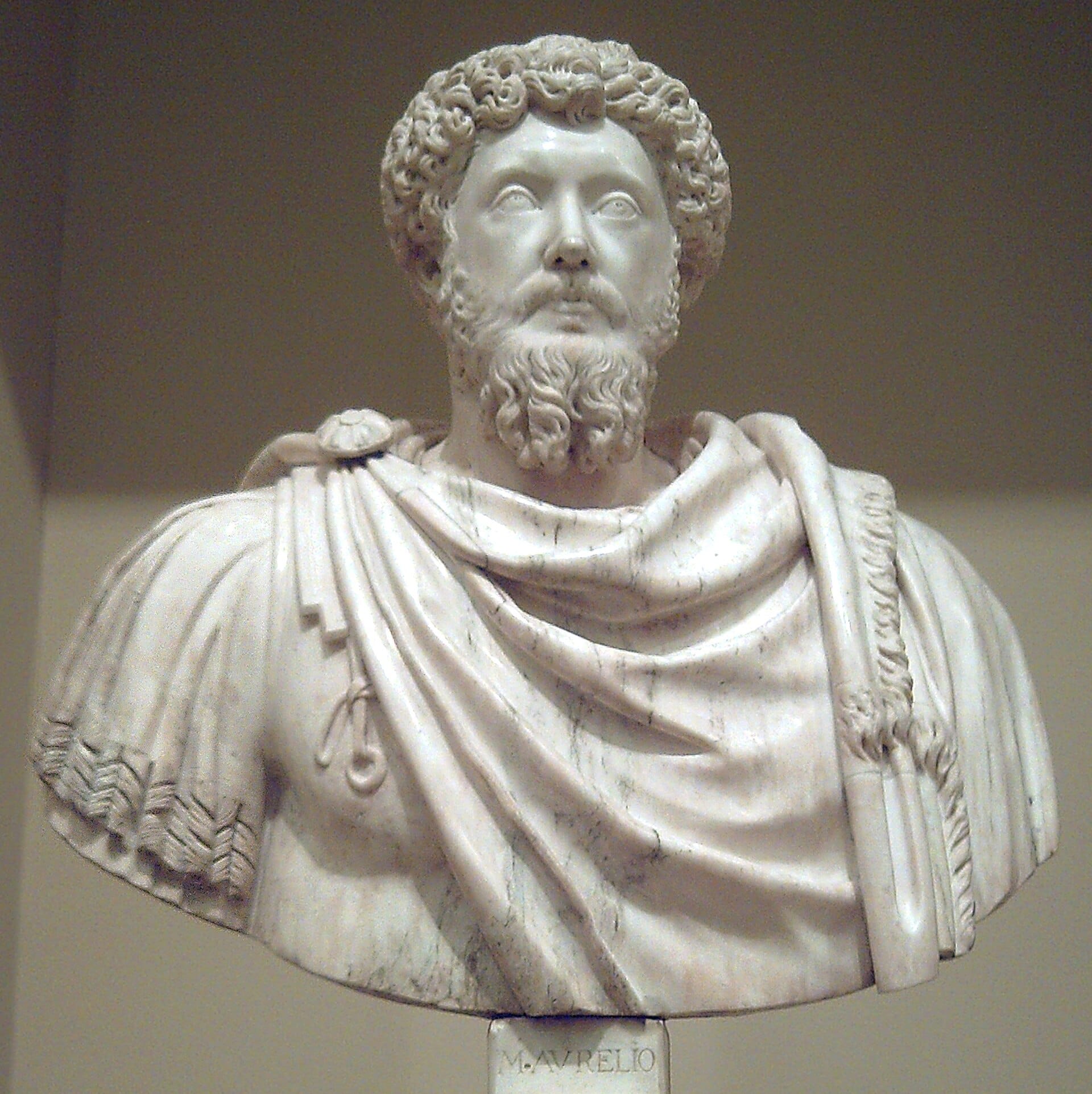
Marcus Aurelius, Roman emperor and stoic philosopher. The Prado bust captures the man who wrote the most important philosophical text ever produced by a person in power. Image credit: Luis García (Zaqarbal), Wikimedia Commons (CC BY-SA 2.0).
The Historical Context Nobody Tells You About
Marcus Aurelius ruled from 161 to 180 AD — the last of the "Five Good Emperors" and, in many ways, the last good emperor Rome would ever have. His reign was defined by catastrophe:
- The Antonine Plague killed an estimated 5–10 million people across the empire
- Constant warfare on multiple frontiers — Marcomanni, Quadi, Sarmatians, Parthians
- Political instability — co-rule with his father-in-law Lucius Verus, succession crises
- Personal tragedy — he watched multiple children die, his wife Faustina was unfaithful, and he himself died of the plague
And yet — in the middle of all of this — Marcus wrote Meditations. Not for publication. Not for an audience. As private notes to himself. The most powerful philosophical text ever written by someone who actually held power never once mentions "power." It's about something far more radical: how to be a good human being when everything is going wrong.
This matters because it tells us what stoicism actually is. It was not a philosophy for armchair academics. It was a survival technology — refined over centuries by men who faced exile, betrayal, torture, and death, and who refused to let those things define their character.
What Stoicism Actually Is (And Isn't)
Before we go further, let's clear the air. The word "stoic" has been hijacked by popular culture to mean "emotionless." This is wrong on every level.
The Misconception
Stoicism ≠ suppressing emotions. Stoicism ≠ being cold or unfeeling. Stoicism ≠ accepting fate passively.
These are all caricatures that appeared because people read the word "stoic" in a dictionary, not because they read Epictetus, Seneca, or Marcus.
The Reality
Stoicism is a practical philosophy of action built on three core insights:
- Some things are up to us. Some things aren't. Your judgments, your choices, your character — those are yours. The weather, other people's opinions, the economy, whether you get that promotion — those aren't. Wisdom is knowing which is which and investing energy only in what you control.
- Your perception creates your reality. Events themselves are neutral. It's your interpretation of them that makes them "good" or "bad." As Epictetus put it: "People are not disturbed by things, but by the views they take of them."
- Virtue is the only good. Courage, wisdom, justice, and temperance aren't "nice to have." They're the foundation of a life worth living. Everything else — wealth, health, reputation — is indifferent. Not worthless, but not essential to a good life.
This isn't passive acceptance. It's active engagement with reality as it actually is, not as you wish it were.
The Three Disciplines: The Architecture of "The Obstacle Is the Way"
Ryan Holiday's book The Obstacle Is the Way (2014) structures stoic practice around three disciplines that map directly onto Marcus's framework. These aren't abstract concepts — they're a step-by-step operating system for converting adversity into advantage.
1. The Discipline of Perception: See Clearly
"If you are pained by any external thing, it is not this thing that disturbs you, but your own judgment about it." — Epictetus, Enchiridion 5
The first discipline is the hardest because it's invisible. You can't see your own perception the way you can see your actions. But perception is where everything begins.
How it works: When an obstacle appears, your first response is not the event itself — it's your judgment about the event. And that judgment is yours to make.
Consider two people who lose their jobs:
- Person A thinks: "This is a disaster. My career is over. I'm a failure."
- Person B thinks: "This is a forced pivot. What have I been putting off that I can finally do?"
Same event. Different outcomes. Not because of luck — because of perception engineering.
The practical technique: Marcus called this "the discipline of assent" — the practice of pausing before accepting your first interpretation of an event. When something bad happens, don't react. Ask: "What is actually happening here? What am I adding to it?"
The obstacle hasn't changed. But your ability to see it clearly — without the emotional overlay — gives you options that weren't available when you were reacting instead of responding.
2. The Discipline of Action: Move Forward
"Don't explain yourself. Friends will believe you. Enemies will not." — Marcus Aurelius, Meditations 7.54
Once you've seen clearly, the second discipline is brutal in its simplicity: act. Not perfectly. Not completely. But act.
This is where most people fail. They see clearly (or think they do), and then they freeze — paralyzed by the gap between what needs to be done and what they should do. Stoicism doesn't care about "should." It cares about what you can do right now, with what you have.
Historical example: When the 1904 St. Louis Olympic Marathon was struck by extreme heat (nearly 100°F / 38°C), the race became a disaster. One runner collapsed and was revived with brandy and strychnine before finishing fourth. Another was carried across the finish line in an ambulance after collapsing from heat exhaustion. The winner, Thomas Hicks, was given a mixture of egg whites and strychnine by his trainers mid-race — essentially a performance-enhancing cocktail that nearly killed him.
What did the stoic approach look like? It looked like Finis Taylor, who dropped out at mile 14 because he couldn't continue. He didn't pretend the heat wasn't there. He acted honestly on what his body was telling him. That's also action — and it's honest action.
The practical technique: When facing an obstacle, ask three questions:
- What can I control right now? (Not tomorrow. Not next week. Right now.)
- What is the smallest useful step toward a solution?
- What would I do if I weren't afraid of failing?
Then do that thing. Not the perfect thing. The useful thing.
3. The Discipline of Will: Accept What You Cannot Change
"Accept the things to which fate binds you, and love the people fate makes your companions, but love them sincerely." — Marcus Aurelius, Meditations 6.22
The third discipline is the one nobody wants to practice because it feels like surrender. But it's not surrender — it's strategic acceptance.
You cannot control everything. Some obstacles are real, permanent, and immovable. A career-ending injury. A natural disaster. The death of someone you love. The Stoics called these amor fati — love of fate — not in a masochistic way, but in the sense of: this is what is. Now what?
The paradox: Accepting reality doesn't mean you stop fighting. It means you stop fighting reality itself and start fighting the problem. There's a massive difference.
Historical example: Stephen Jay Gould was diagnosed with a rare form of stomach cancer at age 21. Doctors gave him two years to live. Instead of spending those two years in despair, he accepted the timeline, focused entirely on what he could control — his work — and went on to become one of the most influential evolutionary biologists of the 20th century. He lived another 40 years beyond his prognosis.
"I don't fear death. I had been dead for billions and billions of years before I was born, and had not suffered the slightest inconvenience from it." — Mark Twain (channeling the stoic tradition)
The practical technique: When you face something truly immovable:
- Name it honestly. No minimization, no exaggeration. "This is bad. This is real. This is happening."
- Separate it from your suffering. The event is one thing. Your mental narrative about the event is another.
- Ask: "Given that this exists, how do I want to live?"
The Stoic Mindset in Action: Four Historical Case Studies
Theory is useful. But stoicism was never meant for theory. Let's look at four people who didn't just talk about turning obstacles into ways — they lived it.
Case Study 1: Abraham Lincoln — The Architecture of Resilience
Lincoln's life reads like a stress test designed by a sadist:
- Poverty in a log cabin
- Death of his mother at age 9
- Failed business ventures (1810, 1831)
- Nominated for Vice President and lost (1856)
- Lost special election to the Illinois Senate (1854)
- Lost race for U.S. Senate (1858)
- Suffered a complete nervous breakdown (1836) — so severe he contemplated suicide
And yet: he became one of the greatest presidents in American history.
The stoic lesson: Lincoln didn't avoid failure. He accumulated it and kept going. Every defeat was data. Every loss refined his judgment. His famous quote captures this perfectly:
"I am a slow walker, but I never walk back."
This is the discipline of action in its purest form. Not speed. Not talent. Direction.
Case Study 2: Viktor Frankl — Finding Meaning in the Unimaginable
Viktor Frankl was a Jewish psychiatrist imprisoned in Nazi concentration camps during World War II. He lost his wife, his parents, and his brother. He witnessed atrocities that most people cannot imagine.
And yet, in Man's Search for Meaning, he wrote:
"Everything can be taken from a man but one thing: the last of the human freedoms — to choose one's attitude in any given set of circumstances, to choose one's own way."
Frankl survived not because he was the strongest or the luckiest. He survived because he found meaning in suffering — and that meaning gave him something to live for. After the war, he went on to develop logotherapy, a form of psychotherapy based on the premise that the primary motivational force in humans is the search for meaning.
The stoic lesson: The obstacle (concentration camp) was absolute. But even there, Frankl found a way — not by changing his circumstances, but by changing his relationship to them.
Case Study 3: Nelson Mandela — The Long Walk to Freedom
Mandela spent 27 years in prison. Twenty-seven years. Most people would emerge bitter, broken, or both. Mandela emerged with a strategy for reconciliation that prevented South Africa from descending into civil war.
The stoic lesson: He practiced all three disciplines:
- Perception: He saw his imprisonment not as a life sentence but as a crucible for leadership
- Action: He organized education programs inside prison, negotiated with guards, and maintained discipline
- Will: He accepted what he couldn't change (the apartheid system) and focused entirely on what he could (his own character)
Case Study 4: J.K. Rowling — The Rock Bottom Advantage
Before Harry Potter, J.K. Rowling was a jobless single mother living on welfare. She was diagnosed with depression. She describes herself as "the biggest failure I knew."
In her 2008 Harvard commencement speech, she said:
"Rock bottom became the solid foundation on which I rebuilt my life."
The stoic lesson: When you hit rock bottom, there's only one direction to go — and there are no more illusions to protect. You see clearly. You act honestly. And you accept that what remains is enough.
The Stoic Toolkit: Practical Techniques You Can Use Today
Theory is beautiful. But you asked for "the obstacle is the way" — which means you're looking for something to do. Here are five techniques, drawn directly from the stoic tradition, that you can start using immediately.
Technique 1: Premeditatio Malorum (Negative Visualization)
What it is: Before starting your day, briefly imagine what could go wrong. Not catastrophize — visualize. Your flight gets delayed. The meeting goes poorly. You get rejected.
Why it works: When something bad happens and you've already imagined it, your brain doesn't treat it as a catastrophe. It treats it as expected. This reduces the emotional impact and lets you respond with clarity instead of panic.
Marcus's version: "You — if only you would take to mind the qualities of the water that gets boiled: how quickly it becomes steam. When the sun shines on it, it disappears almost immediately." — Meditations 7.14
Technique 2: The View From Above
What it is: When an obstacle feels enormous, zoom out. Imagine looking at your situation from the ceiling, then from outside the building, then from space. Your problem shrinks in proportion to reality.
Why it works: Most obstacles feel bigger than they are because we're trapped inside them. The View From Above breaks that cage.
Practical application: When you're stuck on a decision, ask: "Will this matter in five years? In ten?" If the answer is no, invest less energy. If yes, invest more. Simple.
Technique 3: The Dichotomy of Control Audit
What it is: When facing an obstacle, draw two columns. Left: "Things I can control." Right: "Things I cannot control." Be honest. Then focus exclusively on the left column.
Why it works: Most anxiety comes from trying to control what you can't. This technique forces clarity.
Example — job loss:
- Can control: How I update my resume, who I reach out to, how I present myself in interviews, what skills I develop
- Cannot control: Whether a company hires me, the economy, other candidates' qualifications, hiring manager mood
Technique 4: Amor Fati (Love Your Fate)
What it is: Don't just accept what happens. Embrace it. Every obstacle, every setback, every failure — treat it as necessary fuel. Not "I have to deal with this" but "this is exactly what I need."
Why it works: Acceptance without love breeds resentment. Love without acceptance breeds denial. Amor fati combines both — and creates a kind of radical agency that transforms suffering into strength.
Nietzsche's version: "My formula for greatness in a human being is amor fati: that one wants nothing to be different, not forward, not backward, not in all eternity."
Technique 5: The Evening Review
What it is: Before bed, review your day with three questions:
- What did I do well?
- Where did I react instead of respond?
- What would I do differently tomorrow?
Why it works: This is Marcus Aurelius's own practice. He reviewed his actions every evening. Not to beat himself up — to improve. It turns the entire day into a feedback loop for character development.
The Obstacle Is the Way in the Modern World
Stoicism isn't just about emperors and concentration camps. It's about your life, right now, with the obstacles you actually face:
- Career stagnation → The obstacle is the way to develop new skills
- Relationship breakdown → The obstacle is the way to learn what you actually need
- Financial setback → The obstacle is the way to build resilience and resourcefulness
- Health crisis → The obstacle is the way to prioritize what matters
- Creative block → The obstacle is the way to find a new approach
The pattern is always the same: the obstacle contains within it the seed of the solution. Not magically. Not conveniently. But if you look carefully enough — if you practice the three disciplines — you'll find it.
Final Thoughts: Why This Philosophy Endures
Marcus Aurelius wrote Meditations almost 2,000 years ago. The Antonine Plague is long gone. The Roman Empire fell. The barbarians were absorbed or pushed back. But the book is still read — by CEOs, soldiers, athletes, artists, and anyone who needs to keep going when everything says stop.
Why?
Because the obstacles change but the human response doesn't. Fear, doubt, frustration, exhaustion — these are timeless. And so is the answer: see clearly, act honestly, accept what you cannot change.
"The obstacle is the way" isn't a motivational quote. It's a description of how reality actually works. Every breakthrough in history was preceded by an obstacle that someone refused to treat as final. Every person you admire didn't have an easier life than yours — they had a different response to it.
The question isn't whether obstacles will come. They will. The question is: when they do, what will you do with them?
"The best revenge is to be unlike him who performed the injury." — Marcus Aurelius, Meditations 6.6
Further Reading:
- Marcus Aurelius, Meditations (Gregory Hays translation recommended)
- Ryan Holiday, The Obstacle Is the Way: The Timeless Art of Turning Trials into Triumph
- Epictetus, Enchiridion and Discourses
- Seneca, Letters from a Stoic
Tags: stoicism, philosophy, Marcus Aurelius, resilience, personal development, ancient wisdom, Ryan Holiday, Meditations, amor fati, perception, action, will
Feature image: Anonymous Italian / CC BY-SA 2.0 / Wikimedia Commons.
