NSW Solar Rebates for Strata Townhouses & Multi-Unit Dwellings: A Complete Guide

Date: 31 August 2026
Tags: solar, strata, NSW, rebates, townhouse, battery, SoAR, BESS3, body-corporate, energy-policy
The Problem
If you own a strata-titled townhouse or apartment in NSW and want to install solar panels or a battery, you're facing a maze of questions:
- Can I even apply for the SoAR grant, or is it only for apartments?
- What if the roof is technically owned by strata — not me?
- Can I install a battery inside my unit without the body corporate's approval?
- What happens when my dwelling doesn't have its own roof access?
These aren't hypotheticals. They're the exact questions that prevent millions of Australians in multi-unit dwellings from accessing renewable energy incentives. This guide answers them definitively.
The Short Answer
Yes, strata townhouses are eligible for NSW solar rebates. The SoAR grant explicitly covers Class 1a attached dwellings (townhouses) alongside Class 2 apartment buildings. However, the application pathway is fundamentally different from freestanding homes: the Owners Corporation must apply on behalf of all residents, and the electricity generated must be distributed proportionately across all residential lots in the building.
No, you cannot unilaterally install solar on a common property roof. Even if the roof sits directly above your unit, it's almost certainly strata-owned common property. Installing equipment requires either a sustainability infrastructure resolution (simple majority vote) or an exclusive use by-law (75% special resolution).
The NSW Solar Rebate Landscape
Federal Incentives (Available to Everyone)
| Incentive | Coverage | Who Qualifies |
|---|---|---|
| STCs | Upfront discount (~$3,000–$4,500 for 6.6kW) | All residential installations including strata systems |
| Cheaper Home Batteries (CHBP) | ~30% off batteries with solar; up to $9,000 per unit | Primarily freestanding homes — apartments face structural barriers |
The Apartment Penalty: The CHBP's sliding-scale subsidy awards smaller discounts to larger batteries needed for multi-dwelling buildings. As of August 2026, only ~3% of apartments have batteries compared to 7% of detached homes. Allume Energy is actively lobbying the federal government to fix this disparity.
NSW State Programs
| Program | Funding | Coverage | Deadline |
|---|---|---|---|
| SoAR (Solar for Apartment Residents) | $25M total, up to $150K/project | Up to 50% of eligible costs | 4 Dec 2026 or earlier if funds exhausted |
| SoAR Boost | $5M total, up to $200K/project | Up to 80% of eligible costs (selected suburbs) | 4 Dec 2026 or earlier |
| BESS3 Apartment Battery Incentive | Ongoing from Sept 2026 | ~20-40% off batteries | No current closing date |
SoAR Grant: Strata Townhouse Eligibility
The Building Classification That Matters
The SoAR grant defines eligible buildings as:
"3 to 55 residential lots, NCC Class 2 (apartments) or Class 1a attached dwellings"
This distinction is everything:
- Class 1a = detached houses AND one of a group of two or more attached dwellings separated by a fire-resisting wall (row house, terrace house, townhouse, villa unit). Each must be a separate building.
- Class 2 = buildings containing two or more sole-occupancy units stacked vertically.
Strata townhouses are explicitly eligible under SoAR — but only when they qualify as Class 1a attached dwellings with shared rooftop that is common property. This means:
✅ Townhouse blocks where each unit is a separate building (Class 1a) sharing a common roof area, registered under a strata scheme
✅ Apartment buildings (Class 2) with 3–55 lots
❌ Individual freestanding homes — these use the standard solar rebate pathway
❌ Buildings with more than 55 residential lots
Who Applies? The Owners Corporation
Only the Owners Corporation can apply for SoAR funding. Not individual lot owners. This means:
- The strata committee must pass a sustainability infrastructure resolution (simple majority, >50%) at an Extraordinary General Meeting
- A special use by-law must be approved if solar panels will be installed on common property roof space
- The OC must be registered under the Strata Schemes Management Act 2015 (NSW)
- The building must have no solar PV installed in the last 10 years
What SoAR Covers for Townhouses
- Shared rooftop solar PV systems (most common configuration)
- Individual lot solar where panels are on each townhouse's roof but funded collectively through the OC
- Essential meter board upgrades for solar connection
- Solar sharing technology to distribute electricity proportionately among lots
Critical requirement: The electricity produced must be distributed to all residential lots in the building and shared proportionately. You cannot install a system that only benefits one or some lots.
BESS3 Apartment Battery Incentive
Eligibility
Available from 1 September 2026, the BESS3 incentive applies to:
- Apartment buildings in NSW with at least 4 units
- Buildings that have not already used this discount
- Buildings that obtain required planning approval
Battery Requirements
| Requirement | Detail |
|---|---|
| Capacity | Minimum 20 kWh, maximum 200 kWh usable capacity |
| Approval | Must be on Clean Energy Council's approved list |
| Installation | Must be installed outdoors by SAA accredited installer |
| Timing | If installing with solar, must be within 90 days before or after the battery |
The Individual Battery Gap
The BESS3 program is designed for building-level batteries, not individual apartment unit batteries. There is currently no NSW or federal program that provides a direct rebate for an individual strata-titled owner to install a standalone battery inside their lot.
Individual lot batteries would need to be self-funded. The federal CHBP is structured for freestanding homes and does not easily accommodate strata-titled lots.
Roof Access & Common Property: The Legal Framework
Who Owns the Roof?
Under NSW strata legislation, roofs are almost always common property, regardless of whether they sit above a single townhouse or an entire apartment block. This is established in the registered strata plan — the roof space is held by the Owners Corporation for the benefit of all lot owners.
Installing Solar on Common Property: Four Pathways
1. Sustainability Infrastructure Resolution (Simple Majority)
- Passed at an EGM
- Requires >50% of votes in favour
- Covers sustainability infrastructure for the benefit of all owners
- This is the pathway used for SoAR grant applications
- A special use by-law is still needed if individual lots get exclusive access to panels
2. Exclusive Use By-Law (Special Resolution — 75%)
- Grants one lot owner exclusive rights to use a defined area of common property
- Must be passed by special resolution (≥75% in favour)
- Requires written consent from the benefiting lot owner
- Must clearly define the area, specify maintenance responsibilities, and set out conditions/levies
- Must be registered with NSW Land Registry Services within 6 months to be legally effective
- Can only be repealed by another special resolution + written consent, or NCAT order
3. Licence of Common Property
- Less formal than a by-law
- Grants permission to use common property for a defined purpose
- Can be revoked more easily than a by-law
- Often used as an interim solution
4. Strata Plan of Subdivision
- Buy the common property roof space and extend your lot to include it
- Most expensive and complex option
- Requires valuer, town planner, surveyor, and multiple special resolutions
- Only practical for freestanding townhouses with sole roof access
The Problematic Scenario: No Direct Roof Access
What if your dwelling's only access to a usable roof is through or over another dwelling above it, where the roof is technically owned by strata?
Legal reality:
- You have no automatic right to install anything on a roof you don't own
- Even with a sustainability infrastructure resolution, the OC must approve access rights for the lower lot
- The upper lot owner's consent is typically required if the installation affects their property
- Structural engineering assessment is mandatory — drilling into or mounting equipment on a shared roof affects waterproofing, fire separation, and structural integrity of all lots below
Practical solutions:
- Install solar on garage roofs, carports, or side walls if these are part of your lot (not common property)
- Apply for SoAR for a shared building system where generation is distributed proportionately
- Negotiate an exclusive use by-law granting access to the upper roof section (requires 75% OC approval + written consent)
- Install batteries inside your lot if there's no rebate available — self-funded
Individual Battery Installation in Strata Units
Technical Requirements
For individual apartment/townhouse battery installation:
- PDRS compliance: Batteries must meet the Priority Dispatch Rule System standards
- Separate metering: Typically required to isolate the battery from shared building circuits
- Fire safety: Installation must not compromise fire separation between lots (especially critical for stacked dwellings)
- Structural integrity: Roof-mounted batteries require engineering certification
What's Funded vs. Self-Funded
| Item | Funded? | Notes |
|---|---|---|
| Shared building solar (SoAR) | ✅ Yes — up to 50-80% | OC application required |
| Shared building battery (BESS3) | ✅ Yes — 20-40% discount | From Sept 2026, 4+ unit buildings |
| Individual lot solar on common roof | ❌ No direct rebate | STCs apply but no installation subsidy |
| Individual lot battery | ❌ No rebate | Self-funded only; federal CHBP not designed for strata |
Strata Approval Process: Step by Step
For Townhouse Blocks (SoAR Pathway)
- Initial assessment — Engage a solar consultant to assess roof capacity, shading, and estimated generation
- Owners Corporation meeting — Call an EGM; present the solar proposal
- Sustainability infrastructure resolution — Pass >50% vote in favour
- Exclusive use by-law (if applicable) — Pass ≥75% special resolution for any lot-specific roof access
- Register by-law with NSW LRS within 6 months
- Apply for SoAR grant via SmartyGrants portal (OC applies, not individual owners)
- Engage installer — Must be SAA accredited; must offer the OC discount
- Install and commission — Must be completed by 30 April 2027
- Distribute generation — Electricity must be shared proportionately among all residential lots
The SoAR application pathway for strata townhouse blocks follows this sequence:
flowchart LR
    A["1. Initial assessment"] --> B["2. OC meeting"]
    B --> C["3. Sustainability infrastructure resolution"]
    C --> D{"By-law needed?"}
    D -->|Yes| E["4. Exclusive use by-law"]
    E --> F["5. Register by-law with NSW LRS"]
    F --> G["6. Apply for SoAR grant"]
    D -->|No| G
    G --> H["7. Engage installer"]
    H --> I["8. Install and commission"]
    I --> J["9. Distribute generation"]
For Individual Lot Installations
- Check strata plan — Confirm which roof sections are common property vs. lot property
- Apply for exclusive use by-law — Requires 75% special resolution + written consent
- Structural/fire engineering assessment — Mandatory for any roof-mounted equipment
- Body corporate approval — Even with a by-law, the OC must approve the installation works
- Install — SAA accredited installer required
- Register any changes to by-laws with NSW LRS
The individual lot installation pathway follows these steps:
flowchart LR
    A["1. Check strata plan"] --> B["2. Apply for exclusive use by-law"]
    B --> C["3. Structural/fire engineering assessment"]
    C --> D["4. Body corporate approval"]
    D --> E["5. Install"]
    E --> F["6. Register changes with NSW LRS"]
Key Risks & Pitfalls
Common Failure Points
- Funds exhausted early: SoAR is first-in, first-served ($25M). Applications close when funds run out, not at the December deadline
- By-law not registered: An exclusive use by-law is unenforceable if not registered with NSW LRS within 6 months
- Generation sharing violation: SoAR requires all electricity to be distributed proportionately — individual-only systems are ineligible
- Building ineligible: Must have 3–55 lots and no solar PV installed in the last 10 years
Legal Risks
- Installing on common property without approval = breach of strata by-laws, potential NCAT orders
- Damage to common property roof = lot owner liable for waterproofing repairs
- Exclusive use by-law disputes = can only be resolved via NCAT or mutual agreement
Recommendations
For Strata Townhouse Owners
- Push for SoAR application — This is the most viable funding pathway for strata townhouses. The 50% (or 80% in Boost suburbs) coverage makes shared solar economically attractive for all residents
- Start the OC process early — Building consensus and passing resolutions takes time. Funds close early if exhausted
- Consider individual lot solar where possible — If your townhouse has a separate roof that's part of your lot (not common property), you can install independently using STCs alone
- Batteries are self-funded for now — Individual apartment/townhouse batteries have no direct rebate. Budget accordingly or wait for potential program changes
For Apartment Unit Owners
- Advocate for SoAR + BESS3 together — Apply for both grants simultaneously. The combined solar+battery discount is significantly higher
- Engage the strata manager early — They can call EGMs, prepare resolutions, and navigate the SmartyGrants application process
- Monitor federal CHBP reforms — Allume Energy's lobbying may result in apartment-compatible battery subsidies within 12–24 months
Sources & References
- NSW Government: Solar for Apartment Residents (SoAR) Grant Program
- NSW Energy: SoAR Grant Guidelines (PDF, March 2026)
- NSW Energy: SoAR Boost Grant Guidelines (PDF, March 2026)
- NSW Energy: SoAR FAQs
- NSW Energy: BESS3 Apartment Battery Incentive
- Grace Lawyers: Harnessing Solar Energy for Strata Schemes (2025-08-28)
- Wattblock: Solar Readiness for Strata — Section 10 Approvals
- PBL Law: NSW Strata Exclusive Use By-Laws Guide (2025-03-01)
- Benson Legal: Exclusive Use By-Law Options for Common Property (2026-08-03)
- Allume Energy: How to Get Your Strata to Vote for Solar — State-by-State Guide (2025-09-02, updated 2026-06-19)
- Solar Choice: Guide to the SoAR Grant for Strata Apartments (2025-05-04)
- The Energy: Apartment Owners Seek Cheaper Home Battery Program Parity (2026-08-27)
- NSW Government: Guide to 2025 Strata Law Changes
- Bannermans Lawyers: Class 1 vs Class 2 Buildings (2022-10-11)
This report is based on policy documents and legal analysis current as of August 2026. Grant programs, eligibility criteria, and closing dates are subject to change. Always verify with the official NSW government portals before making decisions.
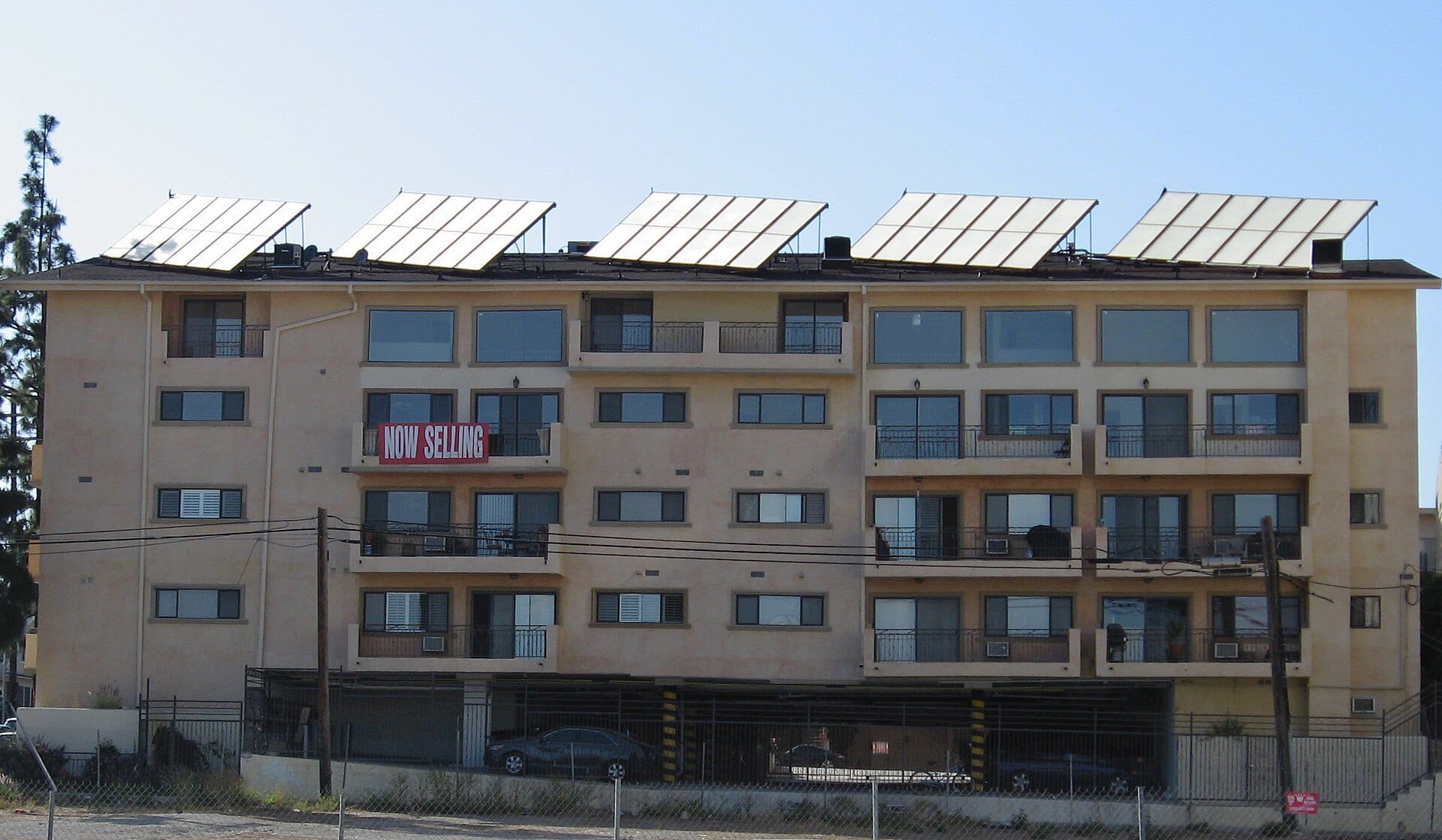
Feature image: Downtowngal / CC BY-SA 3.0 / Wikimedia Commons.
