Kaizen: The Art of Incremental Improvement
How the Japanese philosophy of continuous, incremental improvement transforms organisations, teams, and personal productivity — with practical strategies for implementation.

Kaizen is a Japanese philosophy that translates to "change for the better" — but in practice, it's far more nuanced than a simple call to improvement. It's the disciplined pursuit of small, consistent, sustainable changes that compound into extraordinary results over time.
The Philosophy Behind Kaizen
Unlike dramatic transformations that promise quick wins but often fail, Kaizen operates on a different premise: sustainable improvement comes from thousands of small changes made consistently by everyone in an organisation — not from top-down mandates or one-off projects.
The core principles:
- Continuous improvement: There is always room for improvement, no matter how good things already are
- Small steps: Major breakthroughs come from accumulating many small gains
- Everyone participates: From the CEO to the shop floor, everyone contributes ideas
- Process-focused: Improve the process, and the results will follow
- Standardisation: Once an improvement is found, it becomes the new standard
Kaizen in Practice: The PDCA Cycle
The practical engine behind Kaizen is the PDCA (Plan-Do-Check-Act) cycle:
Plan: Identify an opportunity and plan for change Do: Implement the change on a small scale Check: Use data to analyse the results Act: If the change was successful, implement it more broadly; if not, learn from what happened
This cycle repeats endlessly — each iteration building on the last, creating a spiral of continuous improvement.
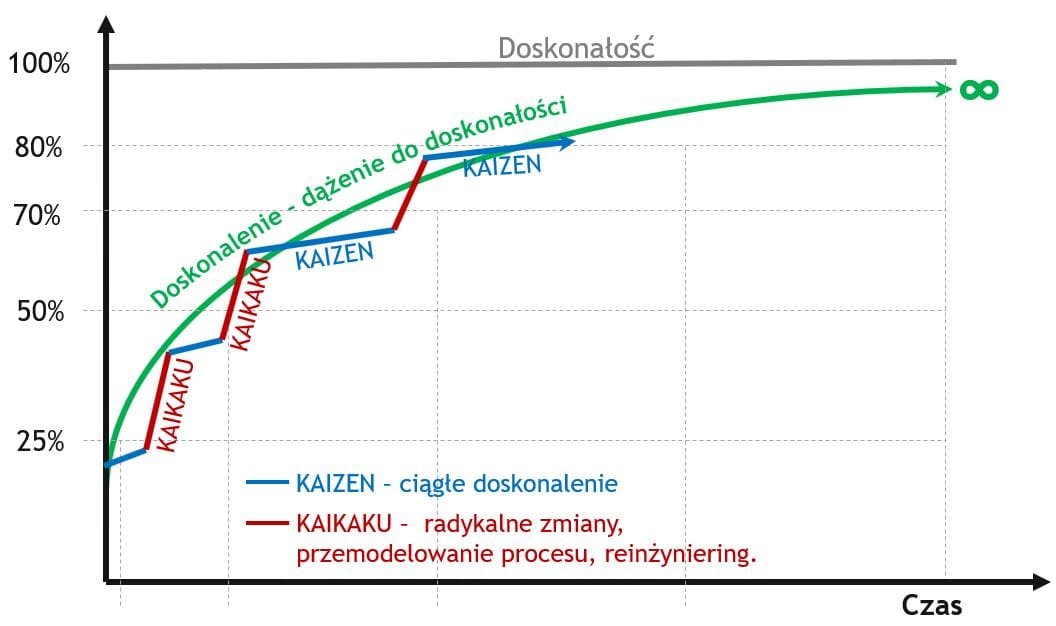
Kaizen vs Kaikaku: Two Types of Change
Kaizen focuses on incremental improvements — small, gradual changes. But there's another concept: Kaikaku, which means radical, transformative change.
Both are necessary:
- Kaizen maintains and steadily improves existing processes
- Kaikaku is the breakthrough that reimagines how things should work
The most successful organisations use both — Kaikaku for periodic leaps forward, and Kaizen to refine and optimise what was created.
Implementing Kaizen in Your Organisation
1. Start Small
Don't try to transform everything at once. Pick one process, one team, or one metric. Make a small improvement, measure the result, and build from there.
2. Empower Everyone
The people closest to the work know it best. Create mechanisms for them to suggest improvements — suggestion boxes, regular improvement meetings, or digital channels.
3. Measure Everything
Kaizen isn't about feelings; it's about data. Track metrics before and after every change to verify that improvement is real.
4. Celebrate Wins
Recognise and reward improvements, no matter how small. This reinforces the behaviour and motivates others to contribute.
5. Make It a Habit
Kaizen only works when it becomes part of the organisational culture — not a programme that starts and stops. Bake it into daily routines, meetings, and performance reviews.
Kaizen Beyond Business
The principles of Kaizen extend far beyond manufacturing and corporate environments:
- Personal productivity: Small daily improvements in habits compound over time
- Software development: Continuous integration, code reviews, and retrospectives are all Kaizen practices
- Health and fitness: Consistent small changes to diet and exercise produce better long-term results than extreme regimens
- Education: Gradual refinement of teaching methods based on student outcomes
The Compounding Effect
The power of Kaizen lies in compounding. A 1% improvement every day leads to a 37x improvement over a year (1.01^365 ≈ 37.8).
This is why Kaizen organisations outperform those that wait for breakthrough moments. They're always moving forward, never standing still.
Final Thoughts
Kaizen isn't a programme you implement; it's a mindset you cultivate. It asks you to look at everything — processes, products, relationships, yourself — and ask: "How can this be 1% better?"
The answer might seem small. But over time, those small answers add up to something extraordinary.
Sources: Kaizen: The Key to Japan's Competitive Success, Harvard Business Review on Continuous Improvement, Lean Enterprise Institute
Feature image: Staworzyński / CC BY-SA 4.0 / Wikimedia Commons.
